Did You Know we offer autism and ADHD assessments for adults?
July 10, 2025
It’s not uncommon for neurodivergent traits to go unrecognised until later in life. Whether you’ve always felt a little different, or certain challenges are becoming harder to ignore, we’re here to help.
Our adult assessments follow the same high standards as our children’s services — including gold-standard tools and a multi-disciplinary team approach aligned with NICE guidelines.
You deserve clarity, understanding, and the right support – at any age.
If you’d like to find out more, get in touch today.

At Berkshire Psychology, we firmly believe that lived experience brings an invaluable perspective, not only to the diagnostic journey but also to the understanding, acceptance, and practical support that follows. We are therefore delighted to be collaborating with Dr Emma Marie Williams of Glitterbrain Psychology, whose expertise is grounded in both professional knowledge and lived experience of ADHD. Clinical Psychologist Dr Em brings evidence-based psychology with high-dopamine delivery, like a neuroscience lecture crashed into a pantomime. With 7,000+ hours of experience supporting people in therapy and a lifetime living with neurodivergence, she offers an inside out approach. Through free resources, low cost live webinars, group therapy courses and 1-1 support you can learn skills that stick, not hacks that slip. The @GlitterBrainPsychology social media platforms share valuable insights, everyday tips and resources. Dr Em dives deep into what’s happening inside ADHD brains and the realities of navigating neurodivergent life. We are excited to welcome Dr Em’s perspectives and look forward to sharing her expertise with the Berkshire Psychology community. Q & A with Dr Em Why is getting a diagnosis important? "I believe that gaining understanding into our brains is what’s hugely important. A diagnosis is just the beginning of exploring that. If we don’t understand what’s going on, it’s harder to communicate our experience. We don't feel understood or even understandable. We try strategies never designed for ADHD brains, then feel hopeless when they don't work. Feeling broken makes us downplay our value, which influences how others see us too. Too often, people with ADHD shame themselves for the way their brain works. I promise that’s not a good use of your energy. I haven’t met someone yet who successfully turned intention into action through self-criticism. Knowledge has the power to stop the shame spiral, and getting a diagnosis can be a gateway to accessing more knowledge about your brain. I think that’s really exciting." Why do people with ADHD struggle to focus? "There are LOTS of layers to this, so I’ll just talk about a couple. People often consider external distractions, but for people with ADHD there are vast internal distractions making it difficult to focus. There is something called the Default Mode Network in the brain, the internal processing system. I call this the ‘Electric Spaghetti Radio’. When we’re resting everyone’s brain wanders freely, scrolling through brain channels like daydreaming, imagining, replaying the soap operas of our life and wandering into weird ideas. It says things like “Ooh, there’s a cute dog. Do you think they should have socks on? It’s cold so we’ve got socks on. But, don’t walkies file their nails? Maybe leg warmers then? OMG, like mini Mr Motivator doggies!” When it’s time to focus, for people that don’t have ADHD, the Task Positive Network activates and the Electric Spaghetti Radio goes much quieter. This allows focus on a particular task. For people with ADHD… it’s not that simple. Some task positive thought pathways emerge… but the Electric Spaghetti Radio stays on full volume in the background. So, those of us with ADHD have to focus through the noise. Of course it’s hard to focus on writing a report when your brain is chattering about dogs getting cold legs. Before you know it we’re sitting on the floor knitting tiny leg warmers, barely aware that we’ve gotten distracted. It’s not intentional, it’s internal. Is ADHD hyperfocus a superpower? "Ok, let’s look at the other end of the focus spectrum. Again, there are many layers to this experience. One is that during hyperfocus the Electric Spaghetti Radio finally gets much quieter in ADHD brains, not quite as quiet as the general population but closer. That’s one of the reasons it can feel so satisfying to hyperfocus, ADHDers can get some relative peace and quiet in their brain, focusing on just one channel for a change. Is it a super power? It depends who you ask. I think of it like this: Superman having laser vision might appear a superpower in some situations. And, if he couldn't control when he switched it on, how long he lasered through things, or what it was aimed at... that would be bad, right? For many, this is what hyperfocus feels like. For me it’s a mixed bag. If I’m able to hyperfocus on something I’m interested in it can feel like a superpower. Other times it feels like it’s stolen days worth of energy on something I wasn’t even interested in. It’s complicated. Hyperfocus also makes it even harder to take breaks, monitor if we need to eat, go to the loo, move that foot we’ve been sitting on for 4 hours. It’s important to consider the consequences of hyperfocus as well as the amazing things we might be able to achieve during that time." If you'd like to find out more, visit www.glitterbrainpsychology.com

Who knew? Well autistic people knew and now we are catching up! At Berkshire Psychology we are committed to offering a dynamic, collaborative and affirmative assessment experience. One that reflects a contemporary understanding of neurodivergence, and a shift away from outdated and harmful stereotypes. We aim to chip away at stigma with fresh understanding. True or False? Autistic = ‘Something Wrong with’ ………False Why would anyone consider that their passionate, gentle, talkative, curious, friendly, intelligent, caring, hilarious, generous, sociable, independent, arty, theatrical, driven, sensible, entertaining, polite, practical, well behaved, mature, studious and or insightful etc child could possibly be autistic? Well…. For too long, autism assessment and diagnosis has focused on medicalised language such as ‘disorder’, ‘deficits’ and ‘symptoms’, with behaviours described as ‘odd’, ‘abnormal’, ‘peculiar’ ‘excessive’ and ‘restricted’. Parents, teachers and clinicians are asked about behaviours that fit with a wholly negative picture with a clear ‘external presentation’. This ’deficit’ model of assessment has dominated for years and has meant that typically, it is those children with highly visible support needs, perhaps around language and communication, personal care, and/or unsafe behaviour, that are diagnosed at a young age. What do we mean by Internal Presentation? In the absence of obvious observable and stereotyped ‘deficit’ behaviour e.g. flapping, poor eye contact, not responding to their name, and solitary play, and in the presence of ‘strengths’ such as well-developed language, good behaviour and intelligence, those with an internal presentation (often but not exclusively girls) have had their autistic support needs missed. The male centric assessment data and research, combined with societal norms and expectations around girls’ behaviour, has meant that autism in girls was explained away differently ‘they’re just shy, fussy, highly strung, bossy, anxious, oversensitive, rude, controlling’’. The Autistic Girls Network says that in the UK, those with an internal presentation (largely girls) are typically diagnosed six years later than those with an external presentation (largely boys) and are often in crisis. As cited in the White Paper published by the Autistic Girls Network, ‘ ’girls aren’t diagnosed later because there is a female phenotype of autism (there isn’t), they are missed for complex reasons the largest of which are masking and presenting internally’ ’. Masking Masking is a safety behaviour and is associated with an ‘internal presentation’. Even young children sense feeling different from others. They might experience confusion, rejection, overwhelm and try to fit in to feel more secure. Masking occurs consciously and unconsciously. It can help people ‘survive’ confusing social situations or help them make friends. Masking includes consciously making eye contact, pretending to like something, hiding distress at noises, practicing conversations and facial expressions, watching and copying others. Sustained masking means a person hides their authentic self. The cognitive and emotional effort required is enormous, with little reward, it is associated with exhaustion, burnout and low self-worth. Widening Our Lens We have listened to autistic people's lived experience, to shape what we do. Those with an internal presentation and fewer visible support needs are often not recognised as neurodivergent and have suffered. While we have referred to this being largely women and girls, it is not exclusively so. Boys and men can mask and present internally too, so the focus on these being female-only issues can also be problematic. In today’s world being autistic is challenging enough but being autistic without knowing is Universally Bad News (author’s opinion) regardless of gender. See Emily Katy: 'Finding out I was autistic saved my life' - BBC News. Conversely, children who are aware they are autistic have been reported to have improved self-advocacy skills, and increased self-awareness of both their strengths and weaknesses (Kiely, et al. 2020). The Autistic Girls Network says, “Autistic girls may be extremely sociable or chatty, or very shy and isolative. It is common for them to have one or two strong friendships, but struggle socialising in groups. A common theme reported by autistic women was to not really feel as if they fitted into the friendship group (Milner et al, 2019). Others felt that they had more difficulty keeping friendships than making them.‘’ Capturing and understanding a person’s social connections, perspectives, masking and sensory experiences forms a valuable part of assessment. A person’s social experience is more nuanced than ‘has friends or doesn’t have friends’. It is shaped by aspects of communication, needs and interests, and sensory experience. Autistic people can and do make amazing friends and enjoy mutually rewarding relationships with shared understanding and connectedness. A note from Dr Jenny Murray, Clinical Director, Berkshire Psychology: Thanks to Anna Maguire for writing this article on our behalf.
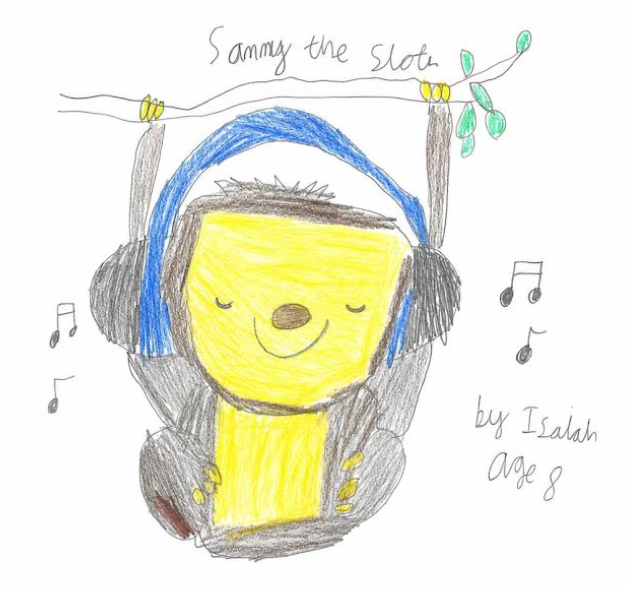
Every now and then we're privileged to receive some limited edition art at the clinic and we wanted to introduce Sammy the Sloth. What a great time it looks like Sammy is having - listening to some perfect tunes whilst swinging from a branch, could life get any better. We wanted to say a BIG thank you to Isalah for taking the time to create this for us, it's been a lovely addition to the clinic and what talent at age 8.